Services · Restorative · Bridges
Dental bridges in Johnstown, NY.
When a tooth is missing and the neighboring teeth are healthy enough to support the load, a fixed bridge restores function and appearance in two visits. We use bridges when they're a better fit than implants, and explain honestly when an implant restoration is the longer-lasting option.
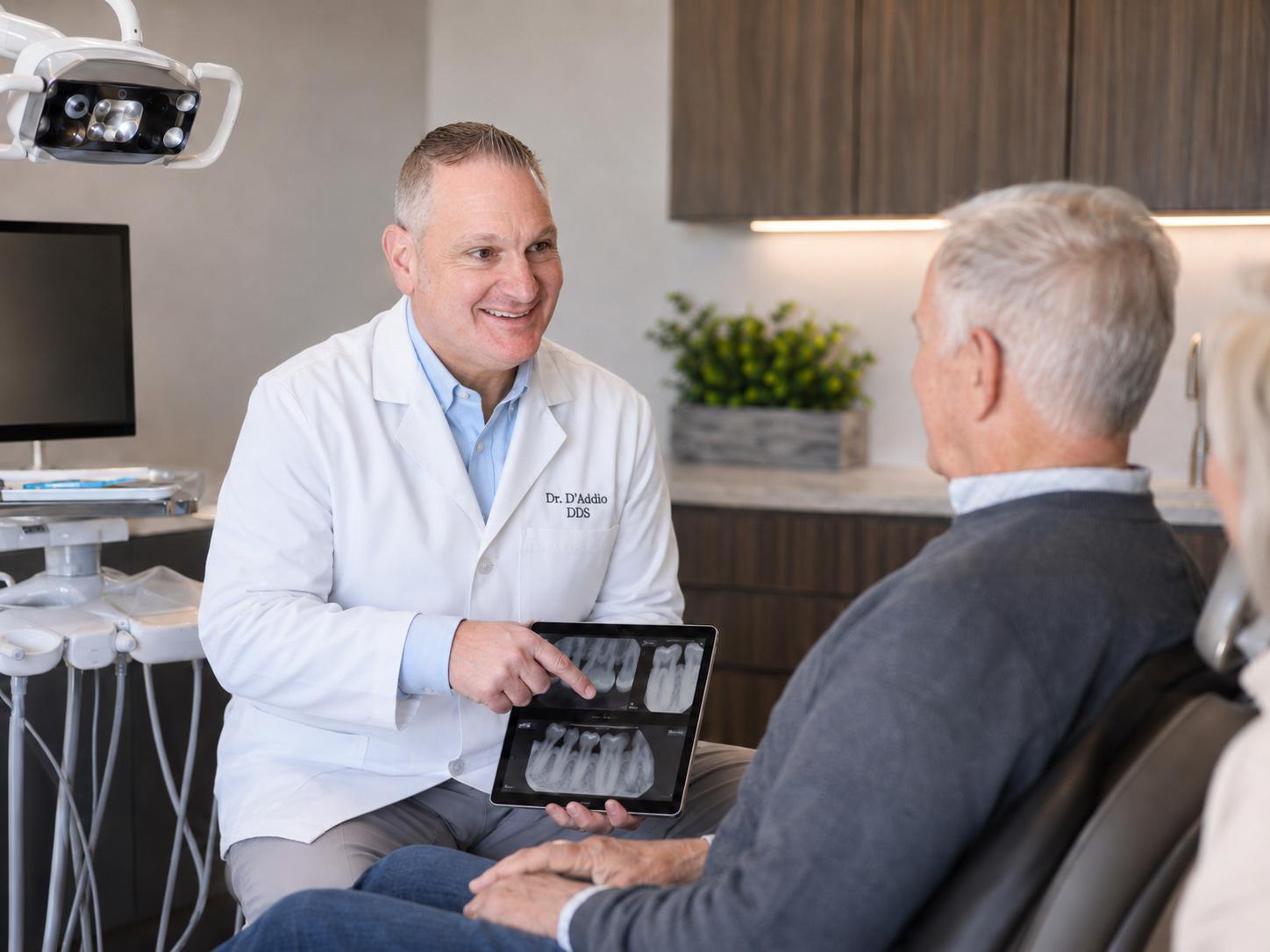
Fixed in place. Made by a lab.
A bridge is anchored to crowns on the teeth on either side of the gap, so it stays put, looks natural, and lets you chew normally without removing anything at night.
Two visits, with a lab step in between
When a bridge is the right answer
Four common bridge situations.
We typically recommend a bridge in one of these scenarios, and we'll talk through the alternatives (implant restoration, partial denture) honestly before anyone agrees to anything.
One missing tooth, with healthy neighbors
If the teeth on either side of the gap already have large fillings or could benefit from crowns, a bridge solves two problems at once, replacing the missing tooth and reinforcing the neighbors.
An implant isn't a candidate
Some patients have bone loss, medical conditions, or budget constraints that make implant placement impractical. A bridge is often the next-best fixed solution.
Two adjacent teeth are missing
A three- or four-unit bridge can span two missing teeth as long as the anchor teeth on either side are strong enough to carry the extra load.
An old bridge has failed
When a bridge fails, we evaluate whether to replace with a new bridge, switch to an implant-supported restoration, or take a different path.
What's included
Two visits, start to finish.
Like crowns, bridges are made by a trusted dental lab between appointments, the precision matters more than the speed.
Bridge candidacy review
We confirm a bridge is the right call vs an implant restoration, partial denture, or leaving the space alone. Honest trade-offs first.
Anchor-tooth preparation
The teeth on either side of the gap are shaped to receive crowns. Local anesthetic, careful contouring, and impressions for the lab.
Temporary bridge
You leave with a temporary bridge protecting the anchor teeth and filling the gap. Wear it carefully while the lab makes the final bridge.
Lab-fabricated final
Porcelain or zirconia bridge made to fit your bite, color, and contours exactly. Cemented at the second visit, bite verified, polished.
Cleaning instructions
Bridges need slightly different home care than natural teeth, floss threaders or water flossers reach under the false tooth. We show you the technique.
Long-term watch
Your hygienist watches the bridge margin and anchor-tooth health at every cleaning. Bridges that get cleaned well last decades.
What to expect
Two visits, three weeks apart.
Same cadence as a crown, just covering more teeth.
-
1
Visit 1: Prep
Numbing, shaping the anchor teeth, impressions for the lab, a temporary bridge, and a bite check.
-
2
Lab time
Two to three weeks of fabrication. The temporary protects the prepared teeth in the meantime, chew on the other side for tough foods.
-
3
Visit 2: Place
Temporary off, final bridge tried in, fit and bite verified, cemented, polished. You leave able to eat normally.
Insurance and cost
Using your benefits out of network.
Dunning is a fee-for-service practice. That does not mean you cannot use dental benefits here. Many patients do. You pay the practice at the visit, we submit the claim to most carriers as a courtesy, and your insurer sends reimbursement directly to you. Card, check, cash, HSA and FSA cards, and CareCredit are accepted. Medicaid and Fidelis are not.
See how insurance works hereYour plan, looked up first
Before work beyond a basic exam or cleaning, the front desk checks your plan and gives you a written estimate.
Claims filed as a courtesy
We submit the claim for you. Your insurer applies your plan's rules and makes the final benefit determination.
Common bridge questions
Questions about dental bridges?
Should I get a bridge or an implant?
How much does a dental bridge cost in Johnstown?
How long does a dental bridge last?
Will a bridge look natural?
How do I clean a dental bridge?
Is a bridge the same as a partial denture?
What if one of the anchor teeth develops a problem?
Will my insurance cover a bridge?
Keep reading
Patient guides on this topic.
Bridge or implant: which fits you?
Two fixed replacement options for a missing tooth. Neither is universally better. How Dr. D'Addio thinks through the decision honestly.
Patient guideImplant placement vs. restoration
Placement is surgery, restoration is the crown or bridge on top. Two phases, usually two providers. How Dunning coordinates with a trusted oral surgeon.
Patient guideTooth extraction vs. root canal
When a tooth can be saved with a root canal and when extraction is the more honest answer, plus what comes next for replacement.
Bridge or implant? Let's talk.
Call (518) 842-3220 and we'll talk through your specific situation. The right answer depends on more than just cost.
Honest dentistry for families who want the long view.