After surgical placement
Implant restorations in Johnstown, NY.
Dunning Family Dental restores dental implants with crowns, bridges, and implant-retained dentures after your oral surgeon places the implant fixture. Serving Johnstown, NY and the surrounding Fulton and Montgomery Counties.
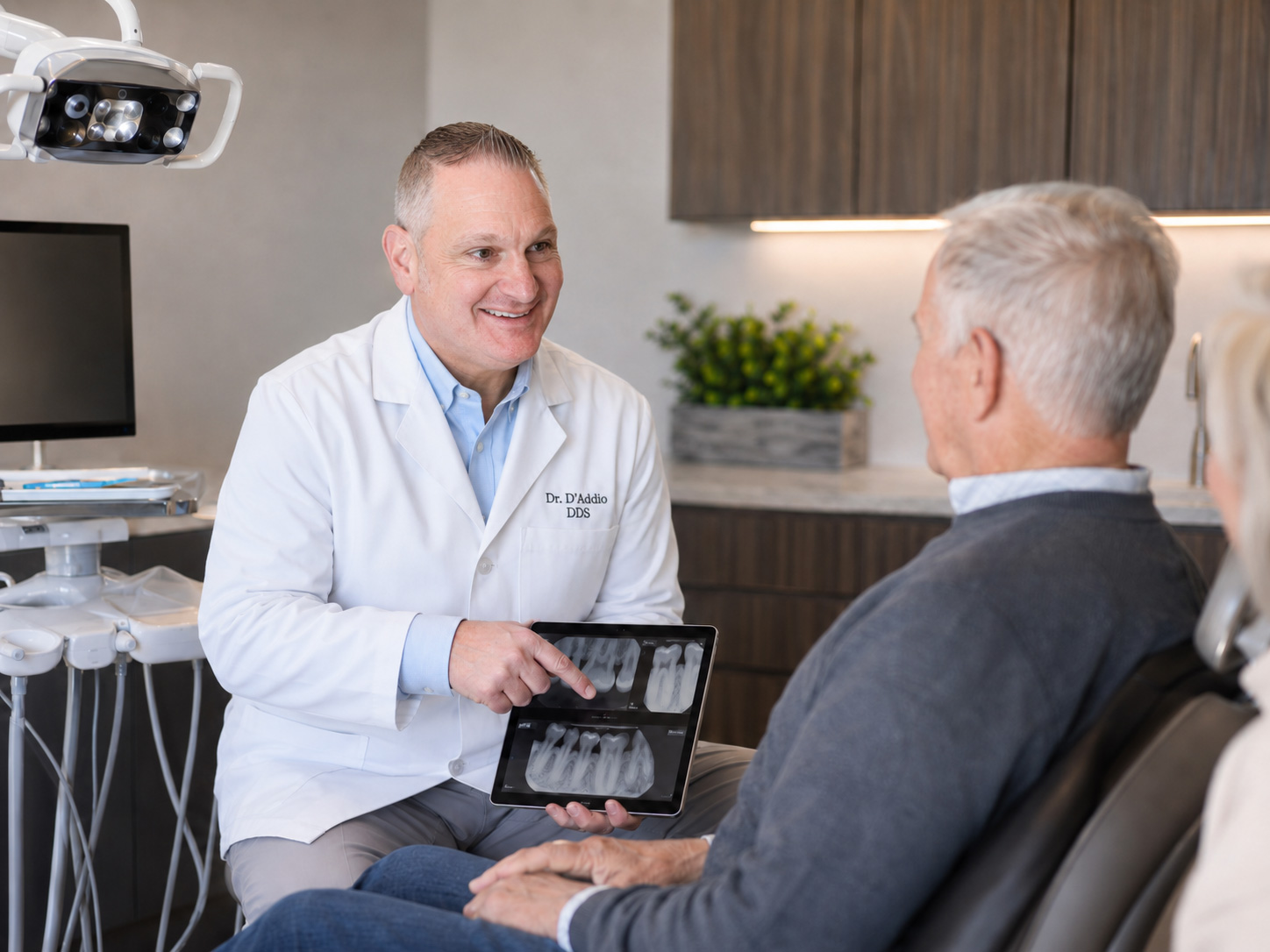
We restore implants. Placement is referred.
Surgical placement of the titanium fixture is referred to a trusted oral surgeon. Once the fixture has integrated with the bone, Dunning restores it with the crown, bridge, or denture that sits on top.
Coordinated care
What Dunning does and does not do
Scope, in plain terms.
- In-house at Dunning: planning conversation, imaging where useful for restorative planning, coordination with the oral surgeon, the crown or bridge or denture that sits on the implant, adjustments, follow-up, and maintenance.
- Referred to a trusted oral surgeon: the surgical placement of the titanium fixture into the jawbone. Any bone grafting or sinus lift procedures required before placement.
- Referred to a specialist when appropriate: periodontal disease treatment that must be resolved before an implant can be placed, or complex medical situations that require additional surgical judgment.
The two-office model keeps surgical judgment with a surgeon and keeps restorative care with the office that also handles your ongoing dental visits.
Situations addressed
When patients ask about implant restorations.
Most implant conversations start with one of these situations. Whether an implant is the right answer for a specific case depends on the neighboring teeth, the bone, the bite, medical history, timeline, and cost.
A single missing tooth
An implant-supported crown replaces a missing tooth without altering the teeth on either side. Whether this is the right choice depends on the specific case.
A failing tooth that cannot be saved
When a tooth is cracked below the gum, severely decayed, or has failed root canal treatment, replacing it with an implant restoration is one option among several worth comparing.
Multiple missing teeth in a row
Two or more adjacent missing teeth can sometimes be replaced with an implant-supported bridge, using fewer fixtures than one implant per tooth.
An existing denture that does not fit
An implant-retained denture snaps onto two or four implants and can reduce movement compared with a traditional denture. Candidacy depends on bone and medical situation.
Alternatives and candidacy
When another option fits better.
An implant restoration is one of several ways to address a missing or failing tooth. The alternatives are not always second best. Each has its own trade-offs.
- A traditional bridge can be the honest answer when the neighboring teeth would benefit from crowns anyway, when the timeline needs to be shorter, or when implant surgery is not a candidate option.
- A removable partial denture is a lower-cost, non-surgical option that some patients prefer.
- Leaving the space is sometimes appropriate for teeth far back in the mouth where the bite load and cosmetic impact are minimal.
The right choice is case-dependent. Dr. D'Addio walks through the options at the planning visit before recommending anything.
Role map
Who handles what across the process.
- Dunning Family Dental: planning conversation, coordination with the oral surgeon, restoration phase (crown, bridge, or denture on the implant), adjustments, follow-up, and maintenance during regular visits.
- Oral surgeon (referred): imaging and surgical planning specific to placement, surgical placement of the fixture, and any bone grafting or sinus lift procedures required beforehand.
- You (the patient): attend both offices for the phases each covers, follow the recovery instructions from the surgeon, and return to Dunning for the restoration and ongoing maintenance.
Two offices means two bills; the coordinated plan makes both clear before the surgical phase starts.
What Dunning restores
What we restore on implants.
Once the implant fixture has integrated with the bone, Dunning takes over the restorative side.
Single-tooth implant crown
A crown attached to the implant fixture via an abutment.
Implant-supported bridge
Replaces two or three adjacent missing teeth on implant anchors, without altering natural neighboring teeth.
Snap-on denture
A removable denture that snaps onto two or four implants to reduce movement.
Fixed full-arch restoration
A non-removable bridge that replaces a full arch of teeth on four to six implants. Coordination-heavy; case selection matters.
Repairs and recementing
Existing implant restorations can loosen at the abutment or chip at the crown. Most repairs are straightforward once the cause is identified.
Implant maintenance and cleaning
Implants do not get cavities, but the gum tissue around them needs the same careful cleaning as natural teeth.
Case-dependent process
How the sequence typically runs.
Three phases across a period of months. Exact timing depends on the case, the bone, and how well the fixture integrates. All timelines are estimates confirmed after evaluation.
-
1
Plan and refer
Dr. D'Addio reviews whether an implant restoration is a candidate option and coordinates a referral to a trusted oral surgeon. Imaging and treatment planning are shared between offices.
-
2
Heal and integrate
After the surgical placement, the implant fixture integrates with the bone. The typical range is a few months; exact healing time is case-dependent and confirmed by the surgeon. Some patients wear a temporary tooth during this time; many do not need one.
-
3
Restore and return
Once the fixture has integrated, Dunning takes the impression, fits the abutment, and places the final crown, bridge, or denture. Ongoing follow-up happens at your regular preventive visits.
Cost and insurance coordination
Two offices, two bills, one plan.
Because two offices are involved, two bills are involved. The surgical placement is billed by the oral surgeon; the restoration is billed by Dunning. Insurance coverage varies significantly by plan. Some cover the surgical phase, some cover the restoration, some cover both, some cover neither. Dunning is out of network and submits claims to most carriers as a courtesy; the insurer makes the final benefit determination. See the insurance and payment page for the full flow. Before the surgical phase, both offices work off a coordinated plan that shows the sequence and expected costs.
Call with payment questionsWritten estimates before treatment
Before the surgical phase, the coordinated plan documents the sequence and the expected costs for each office.
CareCredit is accepted
CareCredit is third-party financing that can spread larger treatment across monthly payments. Approval and terms are set by CareCredit.
Maintenance and repair
Problems with an existing implant.
If an existing implant crown has loosened, chipped, or come off, or the area around it hurts or is bleeding, call the office. Loose or missing crowns are usually re-attachable in one visit once the cause is identified. Pain or bleeding around an implant needs to be evaluated promptly to protect the fixture and the surrounding tissue.
For urgent situations involving an implant, the same phone triage applies as any dental urgency. Call 518-842-3220 during office hours and the front desk will find the earliest appropriate opening.
Common questions
Questions about implant restorations?
Does Dunning place the implant or just restore it?
How long does the whole process take?
How long does an implant restoration last?
Is an implant the right answer compared with a bridge or a partial denture?
How much does it cost?
Where does the process start?
How do I care for an implant restoration?
Will insurance cover any of this?
Related services
Other paths from the same chair.
Restorative dentistry
Crowns and bridges on natural teeth, often a useful alternative worth comparing against an implant.
General and preventive
Implants need the same cleaning and maintenance care as natural teeth.
Emergency dentistry
If an existing implant restoration has come off or is painful, call first.
Keep reading
Patient guides on this topic.
Implant placement vs. restoration
Placement is surgery, restoration is the crown or bridge on top. Two phases, usually two providers. How Dunning coordinates with a trusted oral surgeon.
Patient guideBridge or implant: which fits you?
Two fixed replacement options for a missing tooth. Neither is universally better. How Dr. D'Addio thinks through the decision honestly.
Patient guideTooth extraction vs. root canal
When a tooth can be saved with a root canal and when extraction is the more honest answer, plus what comes next for replacement.
Two providers, one coordinated plan.
Call the office for a planning conversation. The right sequence starts before the surgical appointment.
Honest dentistry for families who want the long view.